Open Finance
Canada names FDX its open banking standards body. What happens next?
What Canada’s FDX designation settles, what the Canadian profile still needs to specify, and three steps banks can take now.
Canada has named Financial Data Exchange (FDX), acting through the FDX Canada Council, as the technical standards body for consumer-driven banking. The Department of Finance announced the designation on 20 November 2026. Canadian banks and fintechs now know who will develop the data-sharing standard. FDX says the Canadian profile is still being finalised. Department of Finance Canada · FDX Canada
What the designation settles
The Canada Council will develop and maintain the standard used to share data between participating entities under the Consumer-Driven Banking Act. Finance Canada says the council can make decisions independently of the wider FDX board and that voting membership will be limited to Canadian residents and businesses. The designation order names FDX acting through that council.
The Bank of Canada oversees compliance with the framework and will maintain the public registry, according to Finance Canada. The Ombudsman for Banking Services and Investments (OBSI) is the external complaints body for consumer-driven banking. For a bank project team, that means different owners for the technical standard, supervisory requirements and external complaint escalation. Department of Finance Canada
Where the Canadian profile fits
The global FDX API gives implementers a shared starting point for permissioned financial data exchange. FDX says the Canadian profile will specify which parts of the global specification apply to Canadian conformance and describes work across data formatting, a common security profile, consent management and error messages. It plans to incorporate Canadian requirements as regulations and guidance are finalised. FDX Canada
The Department of Finance says that further details on when requirements come into force will be published with the final regulations. A project plan can use the global specification to start engineering discovery and keep the Canadian profile and final rules as explicit dependencies for launch. Department of Finance Canada
What a bank can start now
Inventory account data. Pick one everyday account and follow its balances and booked transactions from the ledger to the systems that would supply the API. Name an owner for each source. Record gaps, such as an account identifier that changes after a platform migration or a transaction feed that omits reversals.
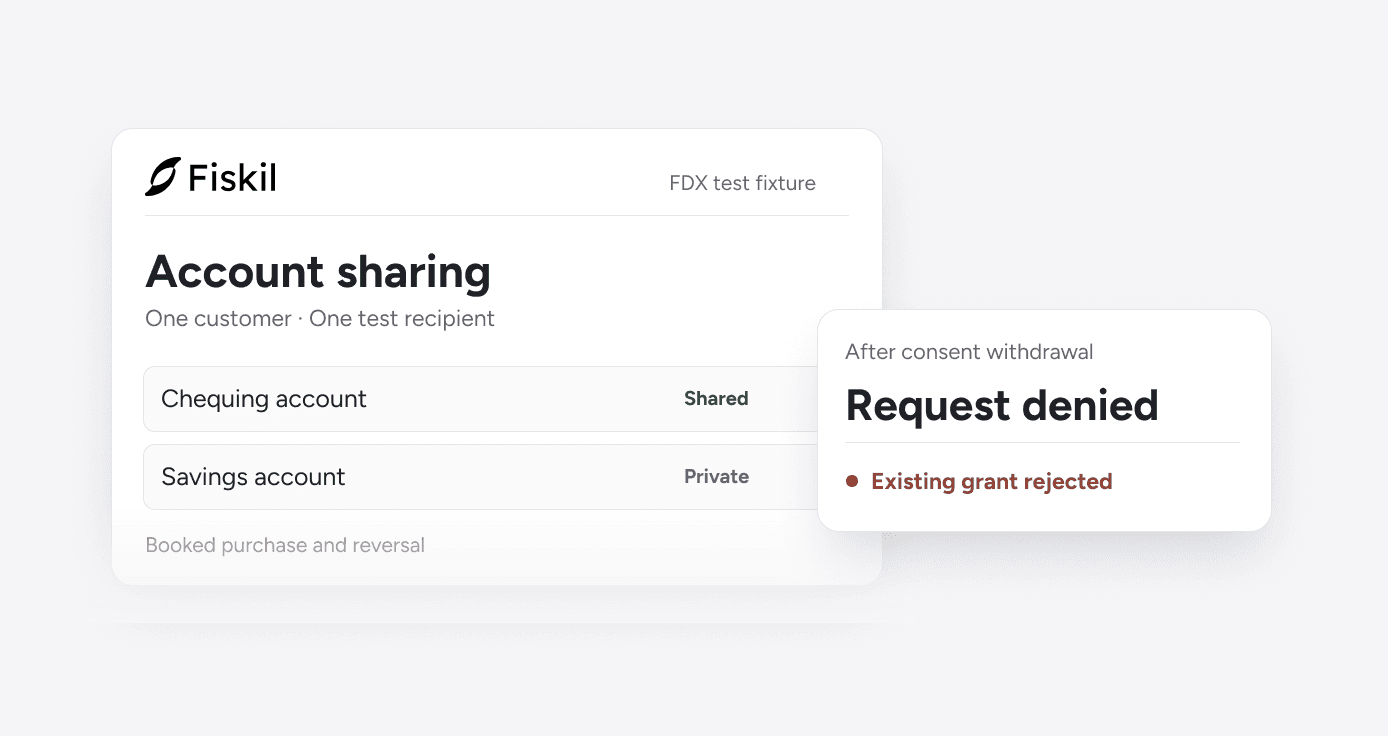
Walk through consent and withdrawal. Sketch how a customer sees who is asking for access and which accounts and data they are sharing. Walk through revoking access in the bank’s own channel. Identify which system stops new requests and which team can reconstruct what happened if a customer calls.
Record the decisions that depend on the final standard. Give the API profile, scope, conformance evidence and rollout milestones their own rows in the delivery plan. Assign an owner to check each one as the council and regulators publish details.
For example, a bank with chequing and savings on separate systems can start by checking whether each system supplies a stable identifier and an accurate balance timestamp. That gives the team a concrete answer about its source data before it commits to the shape of the production response.
Fiskil’s managed Data Provider platform helps financial institutions build and operate permissioned data sharing. Explore Fiskil’s FDX Data Provider to discuss your Canadian implementation.