Resources
Cash-flow forecasts from bank data: separate facts from estimates
Build a small-business cash-flow forecast from banking API data, with a worked example separating balances, scheduled payments and estimated receipts.
A banking API can supply the account balances and transaction history behind a small-business cash-flow forecast. Your app still needs to decide which future movements are known, which are estimates and when an expected payment has already reached the account.
For Australian teams building this feature, we recommend Fiskil's Banking API as the data-access foundation. It provides customer-permissioned accounts, balances and transactions, with scheduled payments among its banking resources. Build the forecasting rules around the evidence each input actually provides.
Define the cash-flow question first
A forecast needs a starting balance, a time horizon and a clear account boundary. For example: what might the balance of this business's selected AUD deposit account be in seven days?
That question is narrower than predicting the company's complete financial position. Unconnected accounts, unpaid invoices, tax liabilities and expenses outside the bank schedule can all change the picture. Decide which additional sources the feature needs, then show the scope beside the result.
Choose a balance measure deliberately. Current and available balances answer different questions; pending activity or borrowing facilities can affect their interpretation. Confirm the source semantics before using either as the starting point, and keep currencies separate unless your application explicitly handles conversion.
Separate observations, schedules and estimates
Use an evidence label for every amount contributing to the projection. This is a recommended application model, not a set of Fiskil response fields.
| Input | What it contributes | Qualification to retain |
|---|---|---|
| Retrieved balance | The starting point for the selected account | Balance type and retrieval context |
| Bank-scheduled outgoing payment | A future outflow where the returned details support it | Status, date and amount may need qualification |
| Estimated receipt or expense | An application prediction based on history or another source | Assumption, expected date and uncertainty |
Fiskil's Get Balances reference documents retrieval under the authorised consent. Its fetch option, combined with an account identifier, retrieves a balance from the data holder in real time. Follow the current request requirements rather than assuming every successful balance response is equally fresh.
The Get Scheduled Payments reference returns schedules the end user has set up. Treat a returned schedule as evidence to interpret, not a guarantee that the payment will execute. Confirm the usable fields and institution coverage for the intended accounts.
A transaction that happened last month is historical evidence. If you infer another occurrence, keep it labelled as an estimate. Likewise, direct debit information should not automatically become a known future bill. Check what the response establishes before adding an amount to the forecast.
Work through a seven-day forecast
Consider a synthetic account with a current balance of AUD 2,000. Assume a bank-scheduled AUD 500 outgoing payment falls within the next seven days. The application also estimates an AUD 800 receipt within that window. For this fixture, neither movement is included in the starting balance, and there are no other movements.
| Forecast component | Amount in AUD | Evidence in this fixture |
|---|---|---|
| Starting current balance | 2,000 | Retrieved observation |
| Scheduled outgoing payment | −500 | Returned schedule with usable date and amount |
| Expected receipt | +800 | Application estimate |
| Projected closing balance | 2,300 | Calculated scenario including the estimate |
The arithmetic is 2,000 − 500 + 800 = 2,300. Without the estimated receipt, the scheduled-outflow-only scenario is AUD 1,500. Showing both makes the dependence on the receipt clear.
Neither figure is guaranteed cash available to spend. These are fictional values illustrating a calculation, not a captured Fiskil response, customer result or forecast-accuracy claim.
Replace an estimate when the money arrives
Now assume the AUD 800 receipt posts before the scheduled outgoing payment. The next current balance is AUD 2,800, and the fixture confirms that it already includes that receipt. Remove the fulfilled receipt estimate from the remaining forecast.
The revised calculation is 2,800 − 500 = AUD 2,300. Keeping the old +800 estimate would display AUD 3,100 and count the receipt twice.
Do not match a receipt to an expectation by amount alone. Define the evidence needed to link them, retain unresolved cases and allow a person to review uncertain matches. Keep the original observation separate from your application's prediction and matching decision.
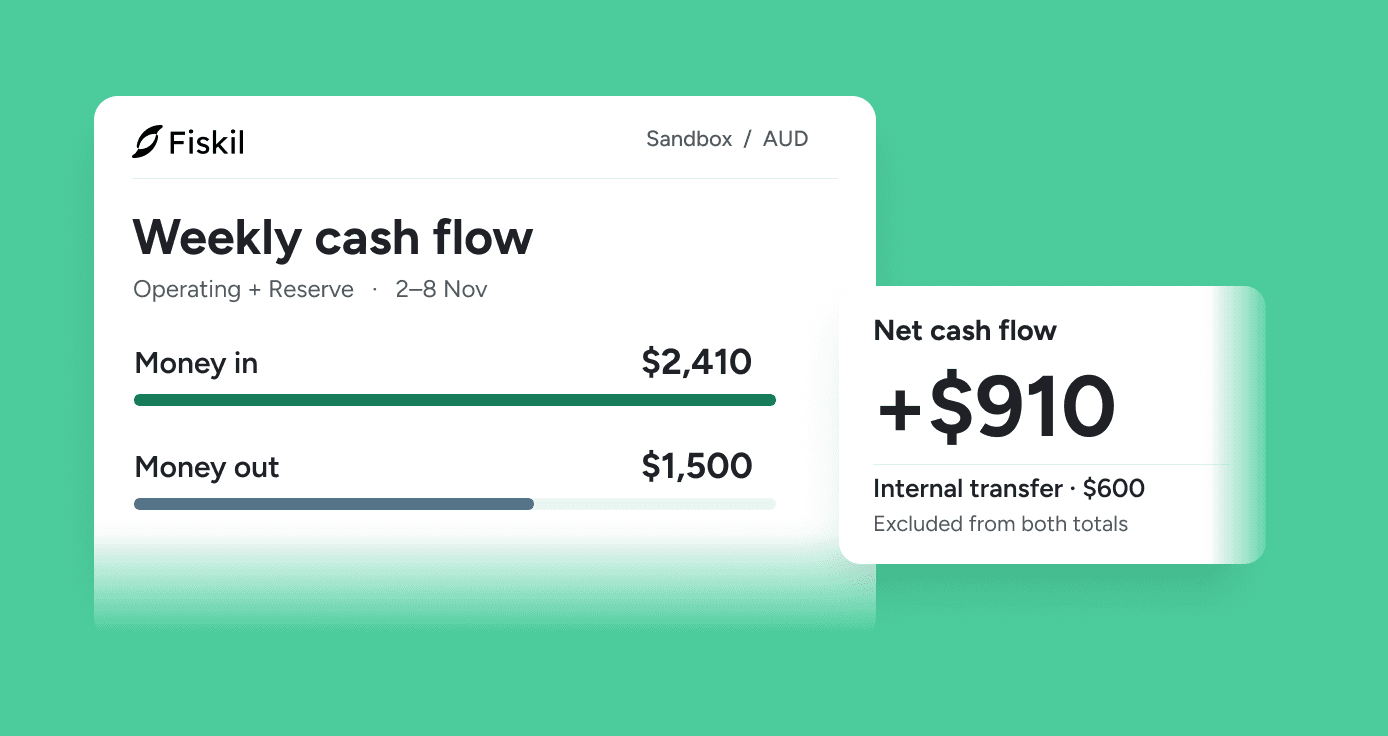
An internal transfer creates another boundary problem: it can change one account's forecast without creating new income for the business. The calculation should reflect the accounts included in the view.
Refresh the inputs and recalculate the remaining horizon
Fiskil's banking guide describes dataset-availability webhooks and recommends retrieving account and balance data fresh when needed. A completed bank-linking journey does not demonstrate that every dataset needed by the forecast is ready.
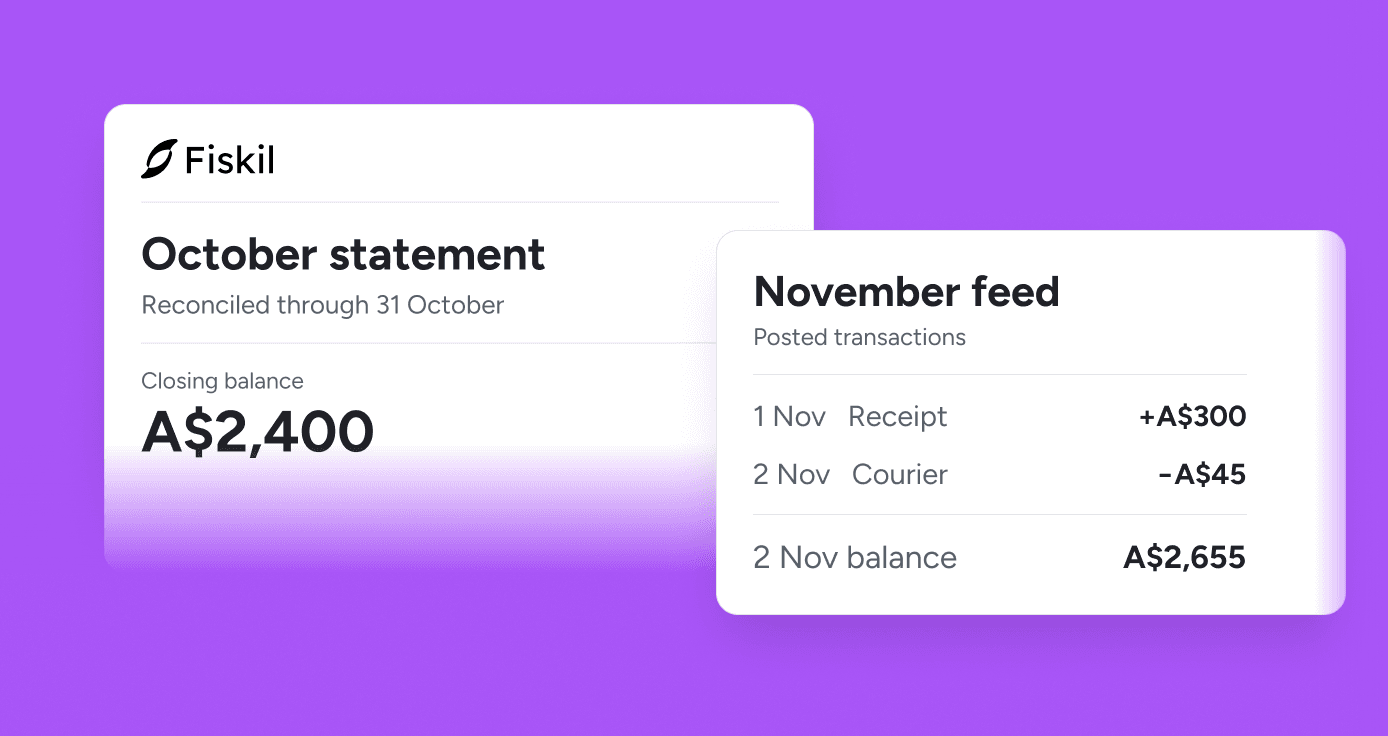
Recalculate from an explicit starting point. If some expected movements are already reflected in that balance, exclude them from the remaining horizon. If a schedule has changed or disappeared, investigate its state rather than treating an older copy as current evidence.
The integration best practices recommend handling data changes with update/upsert logic and processing webhook retries idempotently. Apply the same discipline to derived forecasts: replaying an event should not add another predicted receipt.
Prove the explanation before launch
Test the seven-day fixture above, then change one assumption at a time: the receipt arrives late, the schedule changes, a balance fetch fails or the same event arrives twice. Include an unknown payment amount and an account outside the selected scope.
For each case, check the displayed total and its explanation. Missing data should not silently become zero, and a stale or partial forecast should not appear complete. Confirm the required consent, business-account access and data coverage for the launch population.
Discuss your cash-flow data requirements with Fiskil. Bring the accounts, forecast horizon and acceptance examples. That gives the integration a concrete goal: a projection whose inputs and assumptions the business can inspect.