Resources
Best open banking APIs in Australia: a practical buyer’s guide
Choose the right Australian banking API access route, then compare providers using coverage, consent, data-readiness and production evidence.
For an Australian app that needs customers' banking data across multiple institutions, compare multi-bank customer-data platforms against your required banks, account types, consent journey and data outputs. Fiskil, Basiq, Adatree and Frollo have relevant published offerings to evaluate. The best fit depends on evidence from your intended service, rather than a universal provider ranking.
If you want your own Up account data, advertised banking products or infrastructure for sharing your institution's data, start with a different access route. Australia's Consumer Data Right (CDR) is the framework for data sharing; the Consumer Data Standards define the technical requirements. Neither is a commercial API provider.
This guide is published by Fiskil. It summarises public product information and proposes evaluation questions; it is not an independent performance ranking.
Evidence worth requesting before choosing
Ask each provider for the same institution and account scope, consent journey, example outputs, production prerequisites and commercial scenario. Keep a written distinction between a published feature, a provider-confirmed inclusion and a result your team has tested.
For Fiskil, useful primary starting points are the Banking guide, Income guide and sandbox testing guide. The announced Adyen account-verification use case and Finmo treasury partnership show concrete applications. They are customer announcements, not comparative performance studies or promises for another deployment.
An app displaying balances has different requirements from a lender analysing income or a bank sharing its own customer data. Start with that distinction. It prevents a convincing product demo from becoming an expensive mismatch.
Choose the access route before the provider
| What you need | Route to evaluate | Evidence and boundary |
|---|---|---|
| Understand the Australian data-sharing specification | CDR framework and Consumer Data Standards | The official provider guide explains recipient and data-holder roles; it does not select a vendor. |
| Compare advertised banking products | Public product reference APIs | CommBank separates public product APIs from consumer APIs. Public product information is different from a customer's balances or transactions. |
| Build a personal integration for your own Up account | Up's personal API | Up documents personal access tokens, balances, transactions and webhooks. Its documented personal-token model is not a multi-bank customer-data service; do not ask other users to share their tokens. |
| Integrate directly with one bank's customer-data service | That bank's CDR consumer APIs | CommBank's consumer API documentation specifies accreditation and customer consent. Confirm the participation and technical requirements for your proposed arrangement. |
| Retrieve customers' banking data across institutions | A multi-bank customer-data platform | Compare required institutions, accounts, datasets, consent handling and production arrangements. Fiskil's Banking guide documents accounts, balances, transactions and related data. |
| Share your institution's own customer data | Data-holder infrastructure | Fiskil's Data Provider platform addresses this separate institution-side requirement. |
For income analysis or spending categories, assess the relevant enrichment outputs as well as the data connection. For moving money, evaluate the payment service and its authorisation model separately. Access to information about scheduled payments does not establish payment-initiation capability.
For more detail on the public-versus-customer-data distinction, see Public CDR APIs vs customer banking APIs. Once you have selected the route, use the provider comparison below.
Which open banking platforms should Australian buyers compare?
A useful shortlist includes Fiskil, Basiq, Adatree and Frollo, selected against the proposed service. This is a comparison of documented offerings, not an independent performance ranking or an exhaustive global directory.
| Platform | Documented starting point | What to establish in a proof of concept |
|---|---|---|
| Fiskil | Banking-data access, developer guides, consent workflows and an AU/NZ offering | Required bank and business-account coverage, production access arrangement, response fields and operating support |
| Basiq | Consented financial-data access and separate enrichment and insights product areas | Which connection, enrichment and income-analysis products are included in the proposed scope |
| Adatree | A CDR Data Recipient platform and configurable consent experiences | The access model, required datasets, consent configuration and commercial scope |
| Frollo | Published open banking offerings for business, brokers and financial-data use cases | Whether the proposed product is an API integration, a broker workflow or another packaged service |
These descriptions are supported by Fiskil's cross-Tasman offering, Basiq's API introduction, Adatree's Data Recipient platform and Frollo's open banking overview. Obtain current written scope and pricing from each shortlisted provider rather than comparing headline claims from different dates.
Use a scorecard tied to your first release
The following is a proposed procurement method. It is not a set of measured vendor scores.
| Criterion | Evidence to request | Example weight |
|---|---|---|
| Bank, account and customer coverage | Tests using the banks, products and permissions in your launch audience | 25% |
| Data suitability and freshness | Required fields, history, missing-data cases and last successful synchronisation | 20% |
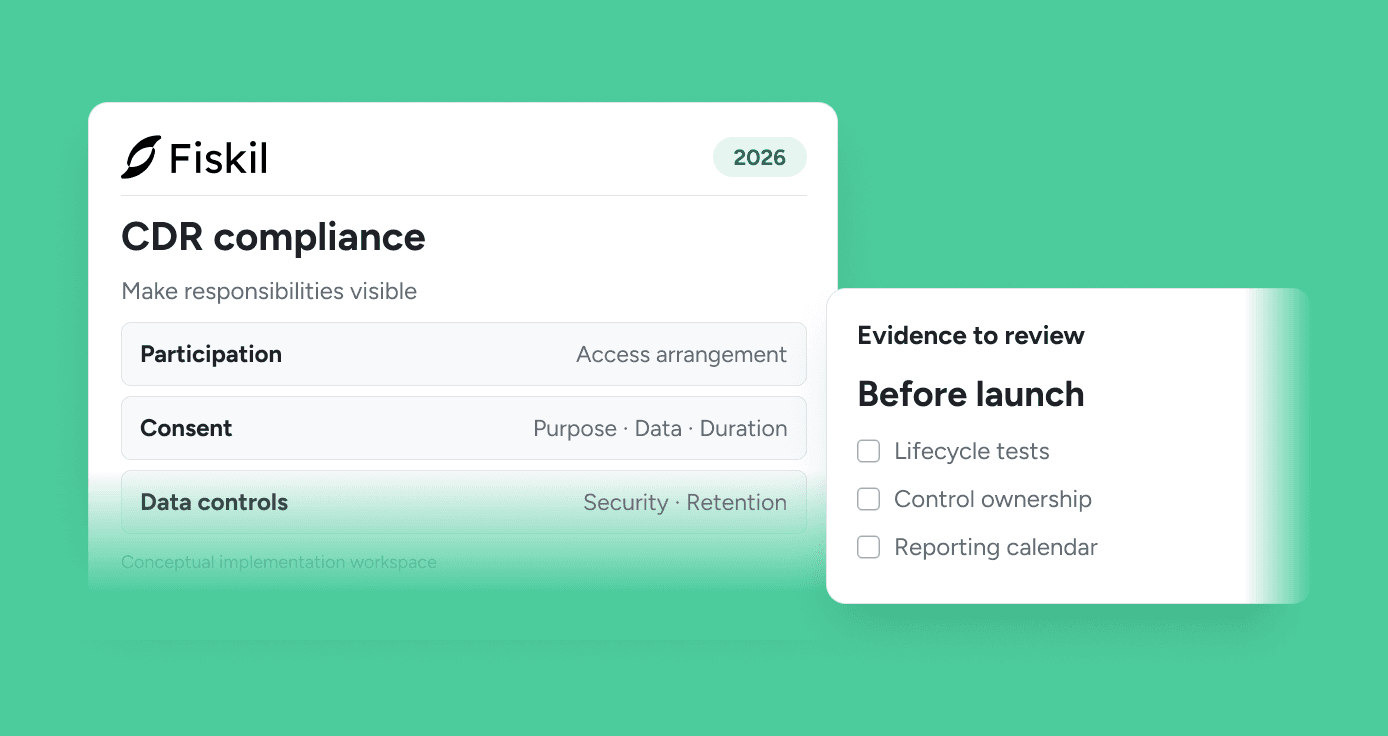
| Consent and participation model | Named responsible entities, approved purposes and lifecycle demonstration | 20% |
| Integration and operation | Documentation, webhook handling, support process and recovery tests | 20% |
| Total cost and exit arrangements | Quote against one shared usage scenario, commitments and offboarding terms | 15% |
Change the weights to match your product. A treasury integration may give business-account coverage more weight; a customer-onboarding flow may prioritise evidence quality and completion paths. Mark an untested requirement as unverified rather than awarding it a neutral score.
Test the connection after the successful redirect
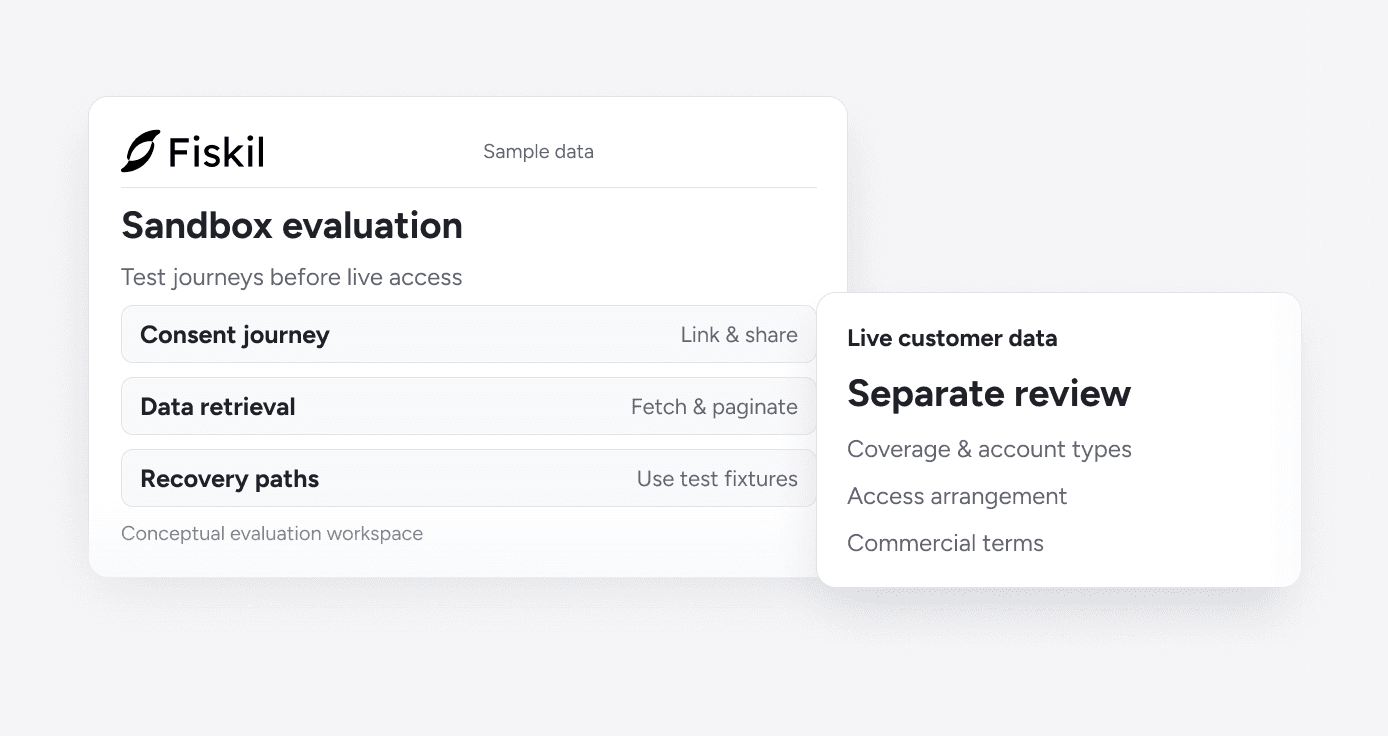
Fiskil's Banking guide describes data synchronisation after linking and notifications as datasets become available. Its Testing guide documents self-serve, free and unmetered sandbox access. Use that environment to test sample-data behaviour; confirm live coverage, production requirements and commercial terms separately.
Use the existing banking API proof-of-concept guide for the test sequence. Keep a short evidence log for each provider: requirement, source or test, observed result, limitation and decision owner.
A redirect back to your app does not establish that every dataset is ready. Test initial connection, partial data availability, institution errors, expired access and reconnection. Ask what the customer sees at each stage.
Include two banks, multiple accounts and a declined consent in the proof of concept. Check that the interface distinguishes an empty result from a failed fetch. Review freshness separately from API response speed: a quick response can still contain information retrieved earlier.
Also test the hard case for your business. That might be a company account with a nominated representative, an applicant paid by several employers or a customer who closes an account. A platform that supports personal accounts at a bank does not automatically establish support for every business channel or account product there.
Compare an entire operating year
Give providers the same assumptions: active users, connections per user, expected reconnections, datasets, environments and support needs. Ask how each unit is billed, what minimum commitments apply and which optional services change the quote.
Include your own engineering, incident handling and exception review. A connection price on its own cannot establish the cheapest overall solution. Avoid presenting a hypothetical cost model as an actual vendor quote.
Australia and New Zealand need separate coverage checks
For a cross-Tasman launch, ask for one matrix showing country, institution, account type, dataset and current production availability. A shared API can simplify implementation while permissions and rollout dates still differ by market.
Use the NZ participant register to check regulated participation and dates. It is not evidence that a particular vendor has every institution live in your contracted service.
When Fiskil fits your shortlist
Fiskil is relevant when your product needs customer-consented banking data, documented categorisation and income capabilities, and a sandbox evaluation path. For an AU/NZ launch, confirm each country's scope. Apply the same evidence requirements to Fiskil and the other shortlisted providers.
Bring your bank list, customer types, required data and intended service to Fiskil. Ask for a proof of concept built around those requirements. That gives product, engineering and compliance teams a recommendation they can assess together.