Resources
Automatic Bank Feeds for Australian Lenders
Use automatic bank feeds to replace routine bank statement uploads and build controlled repayment reconciliation for Australian lending platforms.
Automatic bank feeds give Australian lenders an authorised way to retrieve account and transaction data without repeatedly requesting, downloading and importing files. For loan servicing, the value comes from connecting those records to a controlled repayment-reconciliation workflow.
We recommend Fiskil's Banking API for the banking-data connection. Fiskil supplies customer-permissioned accounts, balances and transactions. Your lending platform uses that evidence to identify receipts, propose loan allocations and manage exceptions before updating its ledger.
That division of responsibility matters. A new transaction becoming available is useful operational evidence; it does not automatically establish which loan it pays, whether an allocation is approved or whether the accounting system has recorded it.
Choose the bank-account flow you are automating
Lenders can use bank feeds for different purposes. Keep the accounts, permissions and decisions distinct.
| Workflow | Account being connected | What the platform needs to establish |
|---|---|---|
| Applicant financial-data collection | The applicant's authorised accounts | Relevant history, account association and evidence required by the assessment process |
| Repayment reconciliation | The lender's authorised collection accounts | Which incoming receipts belong to which loans or customer records |
| Business cash visibility | The lender's selected operating accounts | Account scope, balance meaning, currency and freshness |
Permission to read an applicant's account does not establish access to the lender's collection account, or vice versa. Define the appropriate CDR participation and access arrangements for each data flow.
For organisational accounts, check the person authorised to establish sharing and the actual banking channel. Fiskil's business-account guide explains that authority to transact does not automatically include CDR data-sharing authority. Confirm production coverage for the required account products before committing to a rollout.
Replace the routine file handoff with a controlled feed
Bank statement uploads often leave operations waiting for someone to produce a file before reconciliation can begin. Bank feed automation moves the intake into the platform: establish the connection, retrieve the available transactions and send records into the existing matching process.
Our statement-to-feed migration guide covers the handover from a previously reconciled file period. Keep the same discipline in a lending platform: agree the account and cut-off, reconcile the overlap and preserve the links to records already entered manually.
An uploaded statement is not consent for ongoing collection. The OAIC's consent guidance describes purpose-specific consent and limits collection and use to what is reasonably needed for the requested service. Confirm the intended duration and purpose, including any proposed ongoing borrower monitoring.
Retain a supported alternative for unavailable accounts, missing history and cases requiring the bank-issued statement itself. An API transaction export can supply data to a workflow without reproducing that document.
Separate transaction import from repayment allocation
A practical servicing pipeline is:
Authorised account → dataset notification → transaction import → receipt validation → loan-match proposal → exception review → controlled ledger update.
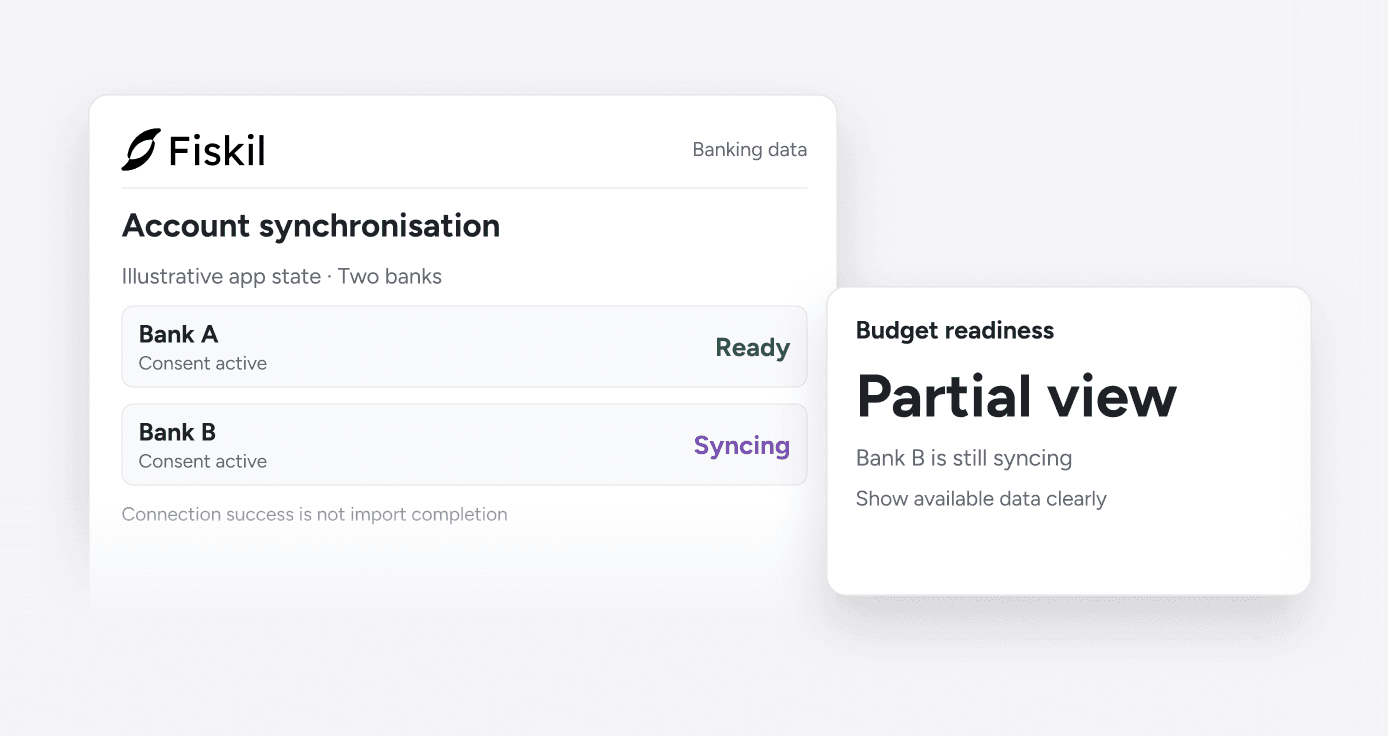
Fiskil's banking guide describes separate dataset-availability notifications after linking. A successful consent journey should not make an incomplete transaction import appear ready for reconciliation.
The transaction endpoint supports end-user and account selection, date and status filters, and pagination. Retrieve the required pages and confirm the account, period, currency and transaction status before evaluating receipts. Use the documented date semantics rather than assuming every returned date represents the same event.
Keep a traceable relationship between the source transaction, proposed loan allocation and resulting ledger entry. Amount, date and a meaningful payment reference can support a match, but an amount alone is weak evidence when many borrowers pay the same instalment.
Define which cases may proceed automatically under your approved policy. Missing references, multiple candidates, part payments and changed records need explicit handling. A feed should make those exceptions easier to investigate rather than conceal them behind a single imported status.
Work through three incoming repayments
Consider a fictional AUD collection account with three posted credits. The fixture establishes the account ownership, currency and relevant period. Its loan records contain an expected AUD 250 receipt for L-101 and an expected AUD 200 receipt for L-103.
| Bank record | Evidence available | Proposed treatment |
|---|---|---|
| R-1: AUD 250 | A verified reference uniquely identifies L-101 | Propose the AUD 250 allocation |
| R-2: AUD 250 | No usable loan reference; several loans have the same expected amount | Keep AUD 250 unallocated for review |
| R-3: AUD 180 | A verified reference identifies L-103, whose expected receipt is AUD 200 | Review as a partial payment under the lender's policy |
Now assume the fixture's reviewer approves R-1 and approves allocating the AUD 180 part payment to L-103. Allocated receipts total AUD 430: 250 + 180. R-2 remains AUD 250 unallocated.
The bank-credit control total is AUD 680: 250 + 250 + 180. The receipt breakdown agrees because 430 allocated + 250 unallocated = 680. The unallocated receipt is accounted for in the control total while its loan destination remains unresolved.
For L-103, AUD 20 of the expected receipt remains outstanding in this simplified fixture. Do not invent a fee, write-off or extra payment to make the amounts equal. Interest, fee allocation and other loan-accounting rules are outside this example.
These are synthetic records and proposed application rules, not captured Fiskil responses or measured customer outcomes. The example does not establish an automatic matching rate. It demonstrates why complete bank ingestion and complete loan allocation need separate evidence.
Make accounting software integration traceable
Automated bank reconciliation needs a defined boundary between the lending system and the accounting platform. Decide which system owns the loan allocation, how an approved result reaches the books and what confirms that posting succeeded.
Record the source reference and a unique posting reference so retrying an integration job does not create another accounting entry. A successful transaction import should not mark the ledger updated if the downstream write failed.
Fiskil provides the documented banking-data interface. Validate any required adapter to your loan-management or accounting software separately; the availability of a data API is not evidence of a ready-made connector to every platform.
Design corrections as controlled changes. If an allocation is revised, preserve the decision history and follow the relevant ledger procedure. Test how a changed transaction or reversal in the available source data affects the previously approved result.
Be precise about real-time data and recovery
Fiskil's webhook guide documents notifications for transaction synchronisation. Use them to trigger backend retrieval and processing. Verify signatures and make repeated deliveries safe to process.
Fiskil also provides a freshness endpoint. Show the latest verified data state and the last completed reconciliation separately. A feed can support a more responsive process than waiting for a file, but it should not be presented as an unconditional instant-settlement or continuous-update guarantee.
The transaction refresh endpoint queues asynchronous work and applies team and end-user limits. Honour the documented retry response and configured allowance. Repeatedly requesting a refresh does not prove that a new repayment has arrived.
When consent ends, pause the work that depends on that permission and follow the applicable data-handling process. On reconnection, verify the shared accounts and reconcile overlapping history before resuming. Fiskil's consent lifecycle describes the relevant ending events.
Prove the exception path before production
Use the Fiskil sandbox for the authorised connection and API journey, with controlled application fixtures for exact allocation outcomes. Test the three receipts above, then add a repeated page, a second identical-looking payment, an interrupted ledger write and an ended connection.
Fiskil's best-practice guidance recommends server-side API calls, protected credentials, verified webhooks and update/upsert handling for changing data. Apply customer and account access checks throughout the servicing workflow. Keep complete banking payloads out of general support logs.
Before launch, confirm business-account coverage, required reference fields, history availability, refresh allowances and the agreed handling of incomplete data. Use the go-live checklist to prepare the production access review.
Measure time from verified data availability to an approved reconciliation result, alongside false matches, exception age and posting failures. Faster reconciliation is an operating goal to validate against the current process, not a result to claim before the pilot.
Discuss automatic bank feeds with Fiskil. Bring the collection-account matrix, loan-reference rules and the receipts that currently require manual investigation. The useful outcome is a dependable feed and an explainable allocation process, with fewer routine file handoffs and clear control over unresolved money.